
AST News
Greg Aikins on Op Persistence, Hidden Wounds, and Remembrance Day
Published on: Tuesday, November 10, 2026 at 11:51 AM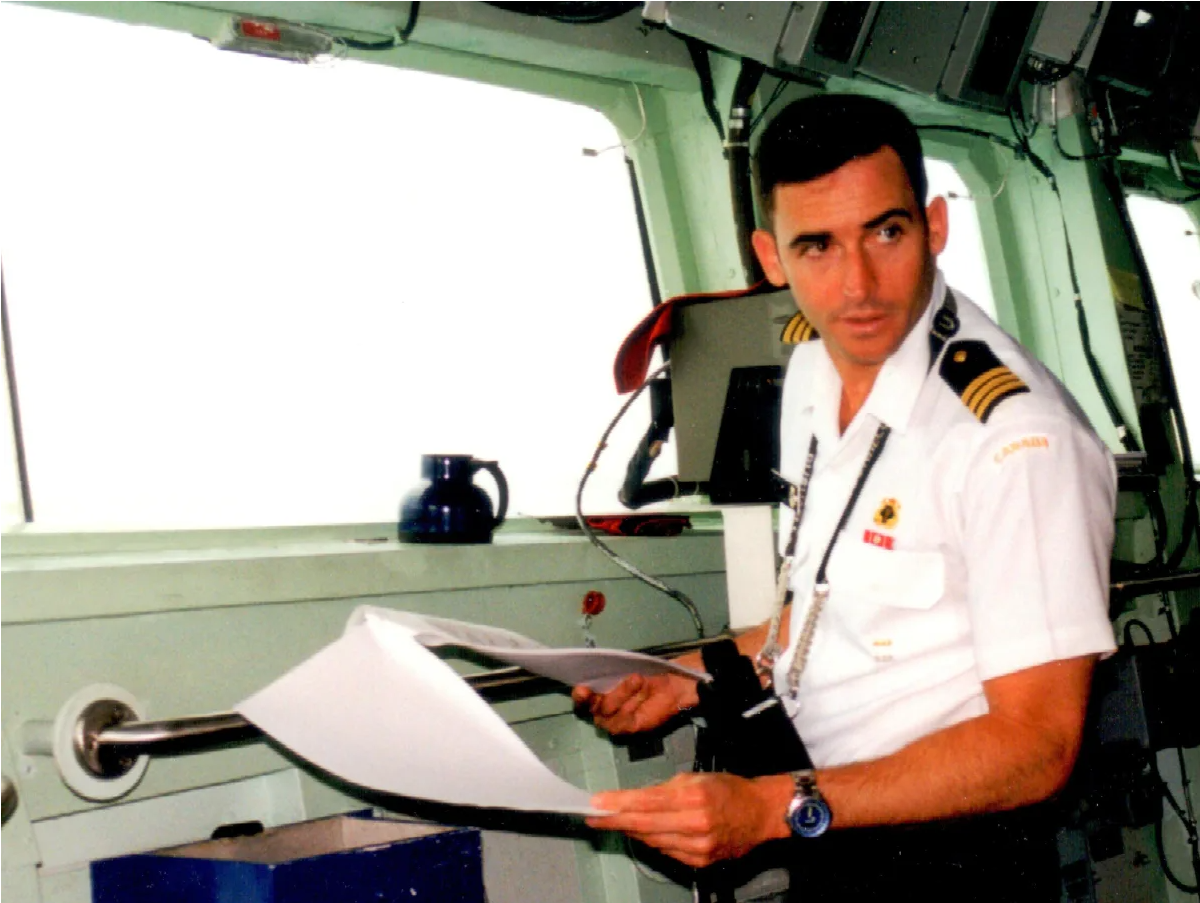
Our minds typically turn to the front lines of conflict when we pause to observe Remembrance Day.
Do we think, however, of the personal story of duty, faith, resilience, and silent struggles carried by a veteran commander long after the mission ends?
In this reflective Q&A, we sat down with Greg Aikins, our Board Chair, veteran naval commander, and alumnus of Atlantic School of Theology. From leading the recovery mission during Operation Persistence (Swissair Flight 111) to finding a renewed journey of faith under Dr. David Deane’s classes at AST, Greg shares candidly about trauma, servant leadership, the critical role of chaplaincy, and how communities of faith can better walk alongside those carrying the hidden wounds of service.
When you think of Remembrance Day today—both as a veteran and a naval commander—what thoughts or faces come to mind first?
I always think of my grandfather, who served as an infantry soldier in the First World War and had a pretty tough war. He tried to enlist underage, and his mother hauled him out. Then he went back as he found out he could enlist legally as a drummer! Of course, he didn't get a drum but a rifle and came back with shrapnel wounds in his head and a missing finger in one hand from a German bayonet.
I was also 16 when I joined the Navy, and so I can identify with being so young in the military. You could join as long as you did not start training until your 17th birthday.
As a Navy guy, I also think of all those sailors in the Second World War who died in the icy waters of the North Atlantic. That seems like a brutal way to die.
As On-Scene Commander during Operation Persistence (Swissair 111), you led a crew through an extraordinarily tragic mission. How did your sense of duty and faith sustain you during such a critical moment?
I think, from a duty perspective, it was an unusual opportunity for the captain of a warship to have operational control over so many other ships and aircraft in a bit of a pressure cooker environment, with the grim situation and media scrutiny. Normally, that scope of command would be done by a more senior officer with a staff to manage all the complexities. My faith at that time was pretty lukewarm, but the concept of servant leadership modelled by Jesus was very ingrained in what I aspired to be and hoped to behave in my leadership.
Remembrance Day often focuses on battlefields, but peace operations and recovery missions carry heavy invisible burdens. How do you think our faith communities can better honour and support veterans who carry the psychological wounds (PTSD) of service?
I think most of us are not seeking special recognition or fuss about our service, but perhaps just low-key acknowledgement. I think a way to honour our journey is to invite active or retired service members into congregational ministries that help people facing challenging times in life. Veterans may not be aware of what they can offer their brothers and sisters through the visible and hidden wounds carried.
You’ve spoken candidly about how trauma can strip away pride and reveal our need for God. What advice do you have for individuals or service members navigating their own “dark night of the soul”?
There’s no doubt that Op Persistence and some of the other challenges I faced were good reminders of how much we all need God in our journeys when we find ourselves on our knees when we’d rather be strong. They were an important catalyst to embarking on a journey of embracing my faith and discovering a relationship with Jesus through that journey.
As Christians we are never alone in the valleys or on the mountaintop, and we need to hold onto that and gaze upon the woundedness of our Saviour, who transforms the world through those wounds. I think the most important thing I can share is that, for me, getting to the point of giving myself permission to have PTSD was a game changer (as the culture then was just beginning to be open about that and put supports in place for service members). Until you can look at it as a real injury, like a broken leg, not a weakness, and begin to look after it and lean on Jesus, it’s not possible to heal.
In reflecting on past military operations, you’ve highlighted how vital authentic spiritual and chaplaincy support is during crisis. How did those experiences shape your understanding of what military chaplains and pastoral leaders need to bring to the field?
My experiences in various deployments in the Navy and particularly Op Persistence underline the criticality of good spiritual support for shipboard morale and operational readiness. I think this is even more important today, as many crew members might not even be aware that they are seeking or need God and just suffer in silence and confusion. Chaplains need to be more open to discussing how the love of Jesus can be transformational. Having said that, the current government has put restrictions on military chaplaincy that make it nearly impossible for them to do their job effectively, as they are not allowed to be overtly religious (which, of course, is a ridiculous oxymoron!).
This militant secular ideology will have a detrimental effect on shipboard morale and the individual welfare of crew members.
What led you to study at Atlantic School of Theology, and how did your time as an AST student deepen or transform your understanding of faith and leadership?
It was an accident, really. A friend of mine invited me to a class being offered by Professor David Deane (now Academic Dean of AST), and I was hooked on a journey of faith seeking understanding. My formation at AST really gave me the tools I needed to coherently share my faith with others and to lead programs of evangelism at my parish, such as Alpha.