
AST News
Raw Conversations and Radical Hope: An Interview with AST’s New Academic Dean
Published on: Tuesday, September 22, 2026 at 2:24 PM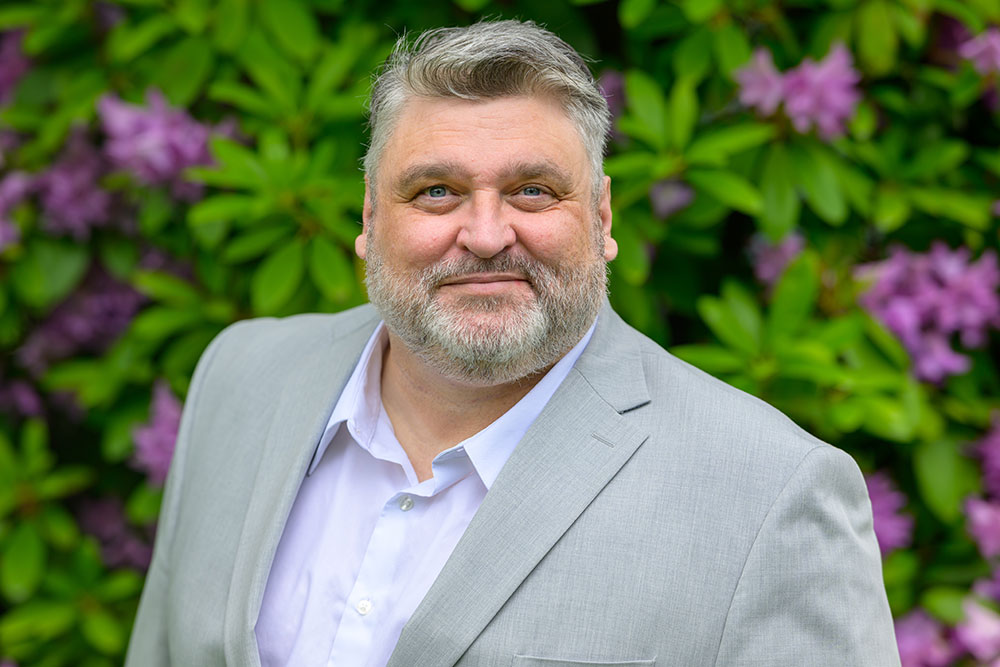
On July 1, 2026, AST had a change in leadership. We welcomed our new Academic Dean, Dr. David Deane.
“I'm coming into this role at an exciting time, when questions about unity, about difference, and about the need to work together more closely are being exposed,” shared Dr. Deane.
“I think we need to feel this, live into it, and encourage it. We can encourage the idea that our differences may not simply be all okay.”
Dr. Deane is an accomplished scholar, author, and educator who is already well-known within the AST community, having served as Associate Professor of Theology at AST for 17 years. He earned his BA, MA, and PhD from Trinity College, Dublin. Before joining the faculty at AST, he served as the Theologian in Residence at Colorado State University.
A versatile teacher, Dr. Deane’s expertise spans Roman Catholic Theology, Christian doctrine, Moral Theology, Apologetics, and Christian anarchism. He is a prominent voice in public theology, frequently providing commentary for radio and television and contributing to major international publications, including the Times of London, the Irish Times, and the Irish Independent.
We caught up with Dr. Deane to discuss his vision for AST, the changing landscape of theological education, and what gives him hope for the Church today.
Having recently taken over as Dean, what excites you most about leading AST at this particular point in its history?
This is such an exciting time in the history of the Church for two reasons, one hopeful and one challenging, and AST is at the intersection of both.
First, the hunger for God, for Christ, for transformation by the Holy Spirit is palpable. We're seeing record numbers of people entering the Church in many locations, including in many parts of Nova Scotia. I was at Mass recently, and there were so many young people in their 20s who didn't know the creed, didn't know when to kneel or sit, and didn't know the responses. This is exciting! Why? Because they haven't grown up in the Church. They're coming with curiosity and openness. They're coming seeking hope and truth and transformation. This is a massive shift from 20, or even 10, years ago. And because of this, it's a fruitful time for theological education, a time when people can come to learn more about this part of reality.
But it’s also a challenging time, because the need for an alternative to the dehumanizing forces of our age, to violence, injustice, naked quests for power, and hatred, has rarely been greater. We need leaders who are themselves being transformed and who can help transform people and the world, and this is what AST is for. So, we have the need, we have the people who want to respond to that need, and AST is a key place where those people can be formed to respond. Everything is in place. This is such an exciting time!
As you begin your tenure, what are your immediate focus areas or goals for the school in your first year?
Well, after all that excitement this is going to seem very boring. My main focus in my first year, and beyond, is to continue the good work of my predecessors in developing the assessments and quality control processes that help us discern whether we’re succeeding in forming the kinds of leaders our age needs.
So many people at AST are working so hard and so brilliantly in their own areas that nobody should be asked to step back and take the whole view as well. That’s the dean's job. And we don’t do it alone. We have partners in the province, in our accrediting body, the ATS, and of course in our founding partners. They help us assess our programs and practices so that we can make the most of the amazing challenge and opportunity that God has placed before us. My focus in the first year and beyond is assessment, quality control, and programmatic improvement.
In your welcome message, you mentioned that our world is facing “deepening isolation, injustice, and fear.” How do you see AST evolving to meet these specific contemporary challenges?
I have some very old-fashioned and maybe uncool perspectives here. I believe our world, marked by savage capitalism, dehumanizing technology, and the re-emergence of the politics of naked power, is producing an age of increasing despair, alienation, and inequity.
The answer to this is not cool or original. It’s that people can flourish and grow in faith, hope, and love through relationship with God, through the indwelling of the Holy Spirit. People can resist this dehumanization, violence, and rage for power by conformity to Christ, the servant, who gave Himself wholly and without remainder for the poor, the broken, and the marginalized. That is the answer. The Church works in the service of this, and we at AST work in the service of the Church. We work to diagnose the situation and to show how union with God, in resistance to tyranny, is possible in this time, the first half of the 21st century, and in this place, Atlantic Canada.
The answer that Christians offer hasn’t changed in 2000 years. The question evolves, and the means of offering that answer and forming people to live it evolves. That’s the work we’re called to, to facilitate transformation and to shape leaders who can transform people and the world.
AST uniquely brings together Anglican, United Church, and Roman Catholic traditions alongside people of all backgrounds. How do you plan to foster and deepen this ecumenical spirit on campus?
In his later years Archbishop James Hayes spoke to us in the AST Chapel. I was expecting a nice talk from a gentle and avuncular figure. Instead, he berated us.
He and the culture he represented were instrumental in the origins of AST. He was a Council Father at Vatican II, and his era brought us together. They overcame suspicion and, in the not too distant past, violence, and the founders of AST made it possible for us to worship together, think together, and teach and learn together. He berated us because we hadn’t moved the needle. We were still congratulating ourselves for resting in our tolerant little silos, while the serious questions about unity, about restoring Christ’s body, and about working together more dynamically to heal a broken world were not being advanced.
I'm coming into this role at an exciting time, when questions about unity, about difference, and about the need to work together more closely are being exposed. I think we need to feel this, live into it, and encourage it. We can encourage the idea that our differences may not simply be all okay. To take a deliberately extreme case, one that nobody here would own: if one person holds that following Christ involves caring for the poor and another holds that it does not, they are not simply both following equally good but different paths. One of them is right and one is wrong. There are many areas where difference is good and welcome, but we need to be okay with having rawer conversations, feeling the awkwardness, and taking seriously the ecumenical challenges we have inherited from brave, radical, and prophetic people.
You highlighted the art of listening across difference as a core value. How can theological education teach students to practice this skill effectively in an increasingly polarized world?
As a student I took classes in philosophy, literature, history, politics, sociology, and theology, and theology was different. It was different, first, because there was real diversity, not just packaged diversity from within the norms of Western culture. When we read our theological forebears, we’re reading people radically different from us in their thinking, and we’re not reading them as history or as “the past.” We’re reading them as dialogue partners who challenge us and whom we need to take seriously. In this, theological education is already serious listening across radical difference.
But there’s more to it. Theology is something you do with your whole self. You don’t come to knowledge of God the way you come to knowledge of inert things, where the object of knowledge is passive. God is active and relational. God transgresses the space between God and us with God’s self-giving. Because of this, in studying God (theology), we are changed by the infusion of something other and greater than ourselves. So our theological work can’t be abstracted from the virtues, from faith, hope, and love. Theological education shapes us in intellectual and moral virtues, and this can help us think better but also be better in a polarized world.
You noted that AST graduates serve in hospitals, classrooms, charities, and grassroots communities as well as congregations. How is AST’s curriculum adapting to equip leaders for these varied secular and non-traditional settings?
This brings me back to my boring answer to your second question. Framed in light of this question, maybe it seems less boring.
So, we have these settings in the 2020s, and this is where many of our grads will go. We then develop a clear sense of what attributes and abilities our grads will need in those specific settings. And then we assess our students, through the program, on whether they are developing those attributes and abilities. What if, halfway through the program, our students are not developing the qualities they need in these settings? That may be a problem with the student, but more often it’s a problem with the program. Why is our program failing to help students acquire these qualities? Is our program equipping them for academic work when they won’t be serving in academic settings? Is it equipping them with skills but without the intellectual ability to inspire and ignite faith in the 21st century?
If the answer is unsatisfactory, then we tweak our programs to do better. And we’ve done this over the years. The grad project was introduced to correlate studies with field settings. Programs of evangelisation were developed to help people respond to the questions those young people from my first answer are bringing. Artistic components were introduced into courses to develop more holistic methods of communication for a more diverse set of contexts. AST’s curriculum reads and responds to these settings, and we will keep doing that in an even more focused way in the coming years.
On a personal level, what grounds your own faith and keeps you hopeful during challenging times in leadership?
The people I relate to most in the Bible are the fools and the sinners. David and Peter have always been special to me, because David was a sinful wretch and Peter, God bless him, was a bit of an eejit. Peter panics time and again, makes mistakes, and even lies and claims he doesn't know Jesus, out of weakness and cowardice. But Jesus loves him and won't abandon him. God loves David. It isn't just, and it isn't fair, because David is weak and, to be honest, a terrible human being, but God loves him and won't abandon him.
I am insanely lucky in that God loves me. And this love is not simply “affection” felt by God towards me. God's love, as Saint Augustine and Saint Thomas make clear, is the Holy Spirit Herself. God's love proceeds from God in and as the Holy Spirit, and we receive and accept union with the Spirit in prayer and in the sacraments. The fruits of that union are faith, hope, and love. Faith, hope, and love, Augustine says in De Trinitate XV, are not gifts from the Holy Spirit. They are gifts of the Holy Spirit. She Herself is the content of the gift.
So I have faith and hope despite the fact that I'm weak, sinful, and a bit of an eejit. I have faith and hope because, insanely, incredibly, God loves me, and that love is nothing less than the Holy Spirit, who IS faith and hope, in my mortal body. I do nothing to deserve this, and I don't deserve it. But in prayer, in the sacraments, and in the moral life, I accept it.
I may be a terrible dean. I may fail and mess up, and who knows what over the next five years? But I am certain that I will continue to have faith and hope, because this comes not from me but from God, and God is good.
If you could share one concise message with incoming students or longtime supporters reading this interview, what would it be?
Come as you are, because none of us qualified for this.
To incoming students: you do not need to arrive knowing the creed, when to kneel, or what the responses are. You need to arrive with the hunger. The rest is what we're here for, and you'll be surprised how many of us teaching you got here by the same road, panicking and messing up and being loved anyway.
To our longtime supporters: you built something at a moment when people had every reason not to. You put Anglicans, United Church folk, and Catholics in one chapel and one classroom when that was still a strange and costly thing to do. That inheritance is not a museum piece. It's a live assignment, and we will take it further for the transformation of a world in need. Stay in partnership with us; we need you.