Resources
Our library resources are curated to meet the needs of today’s diverse learners, whether you are studying on campus or joining us from afar. Through the Novanet consortium and our specialized theological databases, AST provides seamless access to thousands of bibliographic citations, abstracts, book reviews, and peer-reviewed articles. Use the tools on this page to search our catalogue, access OpenAthens for off-campus research, or connect with our library staff for personalized assistance.
Who Can Borrow
AST staff, students and alumni, staff and students from other Novanet Institutions, and residents of Nova Scotia (over the age of 19).
Library Cards
AST staff and students can present their ID card for validation at the Library. AST students, faculty, and staff can borrow items from any Novanet Library. This includes academic libraries in Nova Scotia and Mount Alison University in New Brunswick.
- A replacement card costs $15.00
- If you are an AST distance student, please contact astcirc@astheology.ns.ca or call 902-423-7986 to receive a student ID
Returning Books
Books from AST library can be returned to any Novanet library, or public library in Nova Scotia.
Books from other Nova Scotia library systems (Other academic or public libraries) can be returned to AST through the Borrow Anywhere Return Anywhere (BARA) program. Participating BARA libraries - BARA Libraries.
Renewing Library materials
Books will be automatically renewed for a maximum of 12 weeks
CAAL Borrower's Card
The Council of Atlantic Academic Libraries (CAAL) borrower's card allows registered AST students, faculty and staff to borrow items when visiting Canadian university libraries. This is a free card. AST students, faculty, and staff can get their CAAL card from the AST Library. If you belong to another university, you must get your CAAL card from your university library.
Off-campus sign-in
To access e-books through the Novanet catalogue or electronic journal articles in the EBSCO databases you will need OpenAthens credentials:
Username: starts with "asth"
Password: You will be emailed a link to create your password. If you are a new student and have not received credentials please contact the library at astcirc@astheology.ns.ca.
-
Please use a current recommended browser
Religion & Theology DatabasesEBSCO: Atla Religion Database with AtlaSerials (Full Text) Encyclopedia of the Bible and Its Reception Online (Full Text) Digital Karl Barth Library (Full Text) Oxford Bibliographies: Biblical Studies (Full Text)
|
Multidiscipline DatabasesEBSCO: Academic Search Premier (Full Text) (theological content) ERIC: Education Resources Information Center WorldCatDissertations (Catalogue) Chicago Manual of Style Online 18th edition |
The Chicago Manual of Style
- Chicago Manual of Style Online 18th edition
- (Note: see also their online Citation Quick Guide)
Writing Guides & Resources
Avoiding Plagiarism
-
Menager, Rosemarie, and Lyn Paulos. Quick Coach Guide to Avoiding Plagiarism. Boston: Wadsworth CENGAGE Learning, 2011. Accessed March 6, 2024. http://www.cengage.com/gpms/websites/1133689604/Quick%20Coaching%20Guide%20to%20Avoiding%20Plagiarism.pdf
-
Patrick Power Library. "A Student's Guide to Avoiding Plagiarism." Saint Mary's University, n.d. Accessed March 6, 2024. https://smu.ca/academics/avoiding-plagiarism.html
The Literature Review
-
Bertini, Robert L. How to Write a Literature Review. Asian Institute of Technology: Language Center, 2005. Accessed March 6, 2024. Bertini, Robert L. How to Write a Literature Review.
Recommended eBooks on Research & Writing
- Ekpe, Inyang. Doing Academic Research. Newcastle upon Tyne: Cambridge Scholars Publishing, 2017. Accessed March 6, 2024. https://ebookcentral.proquest.com/lib/astheology/detail.action?docID=5231599
- Francis, Kay. Smart Skills: Presentations. London: Legend Business Books, 2019. Accessed March 6, 2024. https://ebookcentral.proquest.com/lib/astheology/detail.action?docID=5313101
- Fry, Ronald. Get Organized. New York: Open Road Integrated Media, 2018. Accessed March 6, 2024. https://ebookcentral.proquest.com/lib/astheology/detail.action?docID=5448594
- Kibbe, Michael. From Topic to Thesis: A Guide to Theological Research. Downers Grove, Illinois: IVP Academic,2016 . Accessed March 6, 2024. https://search.ebscohost.com/login.aspx?direct=true&AuthType=cookie,ip,shib&db=nlebk&AN=1164264&site=ehost-live&scope=site&custid=s5315951
- Webber, Lousie. Juggling Higher Education and Family Life. London: Institute of Education Press, 2017. Accessed March 6, 2024. https://ebookcentral.proquest.com/lib/astheology/detail.action?docID=5302101
- Wolny, Philip. Strengthening Research Paper Skills. New York: Rosen Publishing Group, 2018. Accessed March 6, 2024. https://ebookcentral.proquest.com/lib/astheology/detail.action?docID=5383671
Recommended Print Books on Research & Writing
- Northey, Margot. Making Sense: A Student's Guide to Research and Writing, 2019. Call #: BL 4405 L35 1984
- Folse, Keith. Blueprints 2: Composition Skills for Academic Writing, 2012. Call #: PE 1128 B59363 2012
- Core, Deborah. The Seminary Student Writes, 2000. Call #: BR 117 C67 2000
- May, Carole. Spotlight on Critical Skills in Essay Writing, 2007. Call #: PE 1471 M39 2007
- Yashjian, Lucretia. Writing Theology Well: A Rhetoric for Theological and Biblical Writers, 2006. Call #: BR 44 Y34 2006
- Vyhmeister, Nancy. Your Indespensable Guide to Writing Quality Research Papers, 2001. Call #: BL 41 V94 2001
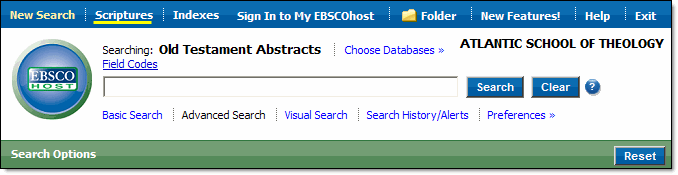
Searching the Research Databases
• Basic Search of the EBSCO Journal Article Databases
• Advance Search of the EBSCO Journal Article Databases
• Exploring Chicago Manual of Style, Online 17th ed
Novanet (book) Catalogue Tutorials
• Finding Books and Placing Holds in Novanet
• Advanced Search Tips Part 1: Boolean Operators
• Advanced Search Tips Part 2: Boolean Modifiers
• Saving Searches in Novanet
• Finding journals in Novanet
Libraries use classification systems to organize items on the shelves. A classification system, such as the Library of Congress Classification System (LC), uses letters and/or numbers (call numbers) to arrange items of the same topic together.
Anatomy of a Library of Congress Call Number
Book title: The Gospel according to Luke.
Author: Michael F. Patella.
Call number: BS 2595.53 P44 2005
The first two lines describe the subject of the book.
-
Bible. N.T. Luke -- Commentaries.
The third line often represents the author's last name.
-
P = Patella
The last line usually represents the date of publication.
-
2005
Tips for Finding Books on the Shelf
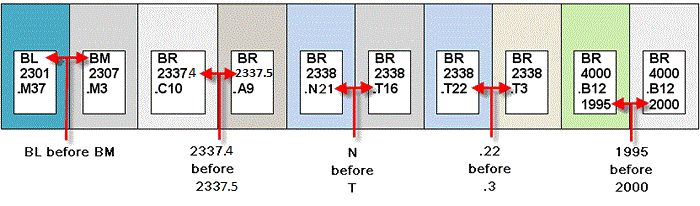
Read call numbers line by line. Consider the call number "BS 2595.53 P44 2005 ".
BS
Read the first line in alphabetical order: A, B, BF, BS, BX, C, D...
2595.53
Read the second line as a number (sometimes with decimal extensions), eg.: 1, 2, 3, 100, 1000, 2000, 2595.53, 2595.54, 2596...
If number has a decimal extension, read the decimals one digit at a time, eg.: .53 reads as "five, three" and not "fifty-three."
P44 (sometimes written as .p44)
The third line is a combination of a letter and numbers. Read the letter alphabetically and read the number as a decimal extension, that is, one digit at a time, eg.: .P433, .P44, .P5... ("four, four" comes before "five").
2005
The last line is usually a date. Read in chronological order: 1985, 1991, 1992, 2005, 2006...
Here is a shelf of books with the call number order explained.
Borrowing Library Materials
A current AST ID card is required to borrow library materials. The loan period for faculty is one academic term. Due dates by term:
• January 30
• May 30
• September 30
Borrowing From Other Libraries
Faculty can borrow materials from other Novanet libraries with a current AST ID card. Please see the list of participating Novanet libraries.
Access to e-resources at other Novanet libraries is restricted to faculty and students at their respective institutions. You will need to visit other Novanet libraries in person to access their e-resources as a guest.
Materials can be loaned from Novanet Libraries and outside libraries for no fee through Interlibrary Loans. This applies to both book and article requests.
Course Reserves (on-campus courses only)
Faculty are asked to place requests to have required readings put on two hour reserve status behind the circulation desk for course use.
AST or Novanet owned books may be requested by contacting Brad Murray.
Please provide the following in your request:
- Book
• Title and call number (i.e. The Study of Liturgy, BV 176 S76 1992)
• If requesting an item from a Novanet library, include library name - Course
• Course name
• Course number
• Name of the instructor
Photocopies can be dropped off at the circulation desk or put in the library mailbox.
Library Instruction
You can arrange library instruction sessions for your courses. The library offers in-class sessions on a variety topics, including:
- Searching the Novanet book catalogue
- Searching the online article databases
- Citing in Chicago Manual of Style
- Writing a literature review
Please contact Robert Martel to book an instruction session.
Sessions are typically 45 minutes to an hour in length and can cover one or more of the topics mentioned above. A minimum of one week advance notice is required for in-class instruction.
Recommending Library Materials
Faculty are encouraged to recommend materials they would like the library to acquire to support their courses and research.
Using The Pine Hill Room and its Collections
The library’s rare book room is open to faculty, for research or class demonstrations and tours. Food and drink are not permitted inside the rare book room. Please contact Heather Moodie to schedule an appointment.
Off-Campus Access to E-resources
When accessing AST e-resources from off-campus you will be required to enter your OpenAthens username and password. Please contact Robert Martel if you experience difficulties logging in.
The Atlantic School of Theology has renewed its licence with Access Copyright.
Access Premium Licence- FAQs for students and staff
Print and Digital Copying Guidelines
The following tools must be used to check if copying is allowed under our Access Copyright Licence:
Access Copyright Repertoire Look-up Tool
Faculty, need to copy more than 20% of a published work in Access Copyright’s Repertoire?
Contact Access Copyright Permission Services
Atlantic School of Theology Copyright Guide
This guide does not provide legal advice. The information contained in this guide is intended to serve as a guideline.
What is acceptable use of copyright protected materials?
- Make a copy from a copyrighted work (e.g. journal article or chapter from a book) for personal research or private study according to Fair Dealing
- Make printouts or photocopies from a copyrighted work for distribution to an entire class without seeking permission of copyright holder. (See 2012 SCC Case Ruling and Fair Dealing for Educational Institutions
- Post a stable or persistent link to a copyrighted work on Blackboard, Brightspace, or other secure CMS or LMS for students access. (Learn how to create stable/persistent links)
- Place a copy from a copyrighted work (e.g. journal article or chapter from a book) on library reserve for a class according to Fair Dealing and our Access Copyright Licence
- Print and copy an array of copyrighted works included in the Access Copyright Repertoire and assemble them into a coursepack for sale to students
- Show a film in class for which public performance rights have been acquired
- Stream a YouTube video in class
What is unacceptable use of copyright protected materials?
- Download a PDF of a copyright protected work and upload it into Blackboard for students access without checking the licensing information and the Access Copyright Repertoire
- Copy an array of copyrighted works, assemble them into a coursepack, and sell them to students without obtaining clearance from copyright holders
- Make a copy of an entire copyright protected work, such as a play or novel, that was published as a volume on its own
- Download a copyright protected video from the internet and distribute the file to students without obtaining clearance from copyright holders
- Make a copy of an entire textbook
Copyright FAQs
What is copyright and what does it do?
The Copyright Act defines copyright as: “the sole right to produce or reproduce the work or any substantial part thereof in any materials form whatever, to perform the work or any substantial part thereof in public or, if the work is unpublished, to publish the work or any substantial part thereof” (Copyright Act, Section 3). Copyright is governed by the Copyright Act (R.S.C. 1985, c. C-42) in Canada and regulates the use and reproduction of creative and intellectual material.
How do I know if a work is protected by copyright?
The Copyright Act advises that copyright exists in “every original literary, dramatic, musical and artistic work” (see Section 5 for more information).
What laws and policies govern the use of copyrighted material at the Atlantic School of Theology?
Use of copyrighted material must comply with Canada’s Copyright Act (R.S.C. 1985, c. C-42) and its Fair Dealing policies.
What is fair dealing and what rights does it give me?
The Canadian Copyright Act defines Fair Dealing as the rights of an individual to use material with attribution for the purpose of research, private study, criticism, review or news reporting. Section 29 of the Copyright Act specifies that “Fair dealing for the purpose of research or private study does not infringe copyright.”
Does AST have any licences that add to my copying rights?
Effective August 2020, AST has a new licence with Access Copyright. The Access Premium Licence with Access Copyright covers paper and digital copying of published works in Access Copyright’s Repertoire. Refer to the Access Copyright website for more information about our Access Premium Licence.
Are there new publishing models that allow more open use of materials?
Yes. Consider using Open Access resources or materials with a Creative Commons License in your courses.
Access Copyright
The Atlantic School of Theology has renewed its licence with Access Copyright.
Access Premium Licence- FAQs for students and staff
Print and Digital Copying Guidelines
The following tools must be used to check if copying is allowed under our Access Copyright Licence:
Access Copyright Repertoire Look-up Tool
Need to copy more than 20% of a published work in Access Copyright’s Repertoire?
Contact Access Copyright Permission Services
Fair Dealing
Fair Dealing- Canadian Copyright Act (Section 29)
Educational Exceptions- Canadian Copyright Act (Section 29.4)
Atlantic School of Theology Fair Dealing Policy (May 2013)
Canadian Association of University Teachers (CAUT) Guidelines for the Use of Copyrighted Material
Read University of Ottawa law professor Michael Geist's post on Assessing Fair Dealing for Education
Works in the Public Domain
The Public Domain includes all works not covered by copyright. Works enter the public domain when copyright expires or the creator of the work chooses to put the work in the public domain, such as publishing works with a Creative Commons license or in Open Access. Copyright lasts for the life of the author, the remainder of the calendar year in which the author dies, and for 50 years following the end of the calendar year.
Although permission is not needed to copy or modify works in the Public Domain, you should always properly cite and source these works. Rules about plagiarism and academic integrity do not have an expiration date.
Screening Films and Videos
An exception in the Copyright Act (Section 29.5) allows a screening of a video, film, or DVD on campus for educational or training purposes. Three conditions must be met in order for this exception to apply:
- The performance must be done on the premises of an educational institution
- The audience must consist primarily of students
- The copy must be legally acquired
Before screening videos, films, or DVDs for a public performance (that does not meet all of the conditions listed above), always ensure that permission has been obtained to show them in public. Commercially purchased or rented videos, films, or DVDs are intended for personal use only and do not include public performance rights, unless otherwise specified. Where possible, the library purchases public performance rights (PPR) and DVDs in the collection are marked to indicate when PPR are included.
Videos available online are usually not for public performance, unless otherwise specified or permission is obtained from the copyright holder.
Copies of videos, films, or DVDs may not be made unless permission is obtained from the copyright owner.
YouTube in the Classroom
You may show a YouTube video in class if it is made available legitimately (e.g. uploaded by the copyright owner) and doesn't indicate that it is for personal use only or it cannot be used for public performance.
Watch this excellent video tutorial from Seneca Libraries (Seneca College) about using YouTube videos in the classroom.
YouTube.com/learning provides access to educational material that is cleared for educational use.
Seeking Permissions (Outside of our Access Copyright Licence)
When the nature or the extent of copying that you wish to do falls outside of Fair Dealing or the the terms of our Access Licence, you must obtain permission from the copyright holder and maintain records of those permissions. Otherwise, you may be held personally liable and subject to the civil and criminal remedies outlined in Part IV of the Copyright Act.
The first step in obtaining permission is to determine who holds copyright on the work. Check the item for this information:
- verso (flip side) of the title page
- slip case of a video, sound recording, or boxed set
- credits statement (beginning or end of a video)
- rights statement on a web page
- accompanying contract or licence
If you are unable to determine who holds the copyright, contact the rights agency for the materials or the publisher to request the information.
Once you have established who holds copyright, you should either fill out a copyright permissions request form on the publisher website or write a letter to the copyright owner or publisher requesting permission to use the material. Your letter should include the following information:
- your name
- name of the institution
- intended use of the material
- intended audience for distribution/performance (e.g., educational, not for profit, intranet users with controlled access)
- intended duration of distribution/performance (e.g., one academic term only, number of times it will be used)
- intended medium of reproduction (e.g., paper, video, broadcast, electronic)
- title of work
- author/editor/creator of the work
- date of publication/production
- time or origin of broadcast
- ISBN, ISSN, catalogue number, program number, or other unique identifier
- chapters, pages, or section to be copied
- number of copies to be made
- provision for payment of royalty fees if any are due
If you receive permission to copy the material keep a copy of the letter, fax or form granting permission for your records.
Legislation
Copyright Act (R.S.C. 1985, c. C-42)
Bill C-11: An Act to Amend the Copyright Act
Copyright Modernization Act (S.C. 2012, c. 20)
Watch CAUT's response to Canadian Copyright Modernization Legislation
Contact for Assistance
Copyright Officer
Rev. Dr. Susan MacAlpine-Gillis
Academic Dean
susan.macalpine-gillis@astheology.ns.ca
Copyright Coordinator
Heather Moodie
Library Co-Chair, Collections Promotion & Development Librarian
heather.moodie@astheology.ns.ca
A feature of our digital library experience, the AST Subject and Research Guides offer students and faculty a streamlined approach to scholarship. By organizing our extensive collection into thematic guides, we help researchers move from broad questions to deep insights. Explore our specialized guides in Biblical Studies, Pastoral Care, Church History, and more to enhance your academic journey.