
AST News
How a Naval Officer Found His Calling in the Arctic and Became AST’s 2026 Valedictorian
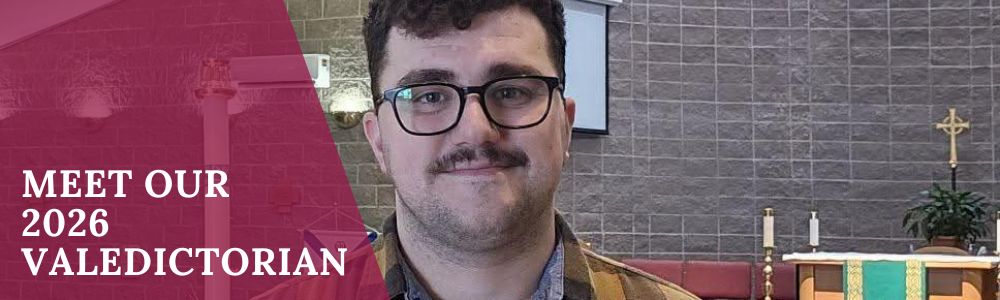
With convocation coming up on May 9, AST is proud to announce that Master of Divinity student Nicholas Lucciola has been named Valedictorian for the Class of 2026. From the bridge of a naval vessel to the halls of AST, Nic’s journey is a powerful testament to the unexpected ways vocation can call to us.
Nic was born and raised in Belleville, Ontario. He joined the Canadian Armed Forces in 2014 as a naval cadet and studied for a Bachelor of Arts in Psychology at the Royal Military College of Canada in Kingston, Ontario, graduating in May 2018. He then served as a naval warfare officer in the Royal Canadian Navy, spending two years in Esquimalt, B.C. before being posted to Halifax, N.S. in the summer of 2020. He continued in that role until the summer of 2023, when he did an occupational transfer within the Canadian Armed Forces from Naval Warfare Officer to Chaplain, having discerned a vocation to the priesthood within the Anglican Church of Canada. Nic began studying for that role by enrolling in the Master of Divinity at Atlantic School of Theology. He currently lives in Eastern Passage, N.S., with his wife Chelsea, their son Julian, and their three cats.
What was the pivot point that led you from your previous career path to Atlantic School of Theology?
The pivot point for me was that while deployed on the HMCS Harry DeWolf in 2021 as a bridge watchkeeper to the Arctic for humanitarian operations and then the Caribbean conducting drug interception, we did not have a chaplain sail with us for those five months. So, I volunteered to take the Sentinel Course taught by chaplains, which made me the designated peer-support person on the ship. I also volunteered to lead the ship’s church services on Sundays at sea. The fulfillment I got from doing this made me realize I wanted to transition into ministry and chaplaincy full-time.
What is one core value from your military service that you found surprisingly relevant to your theological studies?
One core value that really was useful for me was that of discipline and work ethic. Studying for a Master of Divinity is very intense and requires discipline and hard work in order to be successful.
Being named valedictorian is a significant honour. What is the most important lesson your classmates have taught you over the last few years?
It is definitely a huge honour for me to be named valedictorian, and I have learned a lot from my classmates. I think the most important lesson they've taught me is just about the diverse ways that faithfulness can be shaped. There are so many wonderful stories of vocation and faith among my classmates that are inspiring and show the way God is active in all of our lives in such different ways.
Our campus is known for its seaside serenity. Where was your favourite spot on campus to reflect, study, or find a moment of peace?
I have really enjoyed the seaside vibes of AST and love the view from the Flahiff room. I have been known to walk down the beach in front of the President’s Lodge and sit in the sun for some quiet time between classes.
As you prepare to address the Class of 2026, what is the one word or theme you feel best describes this group of graduates?
I feel like the one word or theme that describes our class is "leaders." Not only are so many of us already in or entering church leadership, but the way that my classmates have taken so much leadership in the school and in chapel has been impressive and made it is a cohesive and efficient environment for us all.
What’s next on the horizon for you after May 9? How has AST prepared you for that next chapter?
After graduation I will, God-willing, be ordained in the Anglican Church of Canada and begin a two-year period of full-time ministry in a parish setting that serves as the internship in my military chaplaincy training before I return to full-time service in the CF as a chaplain. AST has done an excellent job of preparing me for parish ministry with its abundance of time spent in supervised ministry placements and rigorous pastoral and theological courses.